
Newcastle keeps one of the better terrace and Federation stocks in the state: the iron-lace rows of Cooks Hill, the grander frontages up The Hill, the workers' cottages of Islington and Wickham, Hamilton's Federation pockets. These houses come with two window facts. Their openings are generous, tall sashes with deep reveals that carry shutters beautifully. And their openings are old: settled frames, plaster reveals a few degrees off square, and shapes, arches, fanlights, that never met a standard size. Both facts should steer what you order.
The pattern language
Inside a period room, three choices make a shutter read as if it was always there. Front tilt, the visible rod, because period joinery showed its workings. Narrower louvres, 63 to 89 mm, in proportion with tall, narrow glass. And painted basswood in the trim colour, not stark plastic-white, so the shutter joins the room's existing paint story. The reasoning behind each lives in the choosing guides: the tilt question and louvre widths.
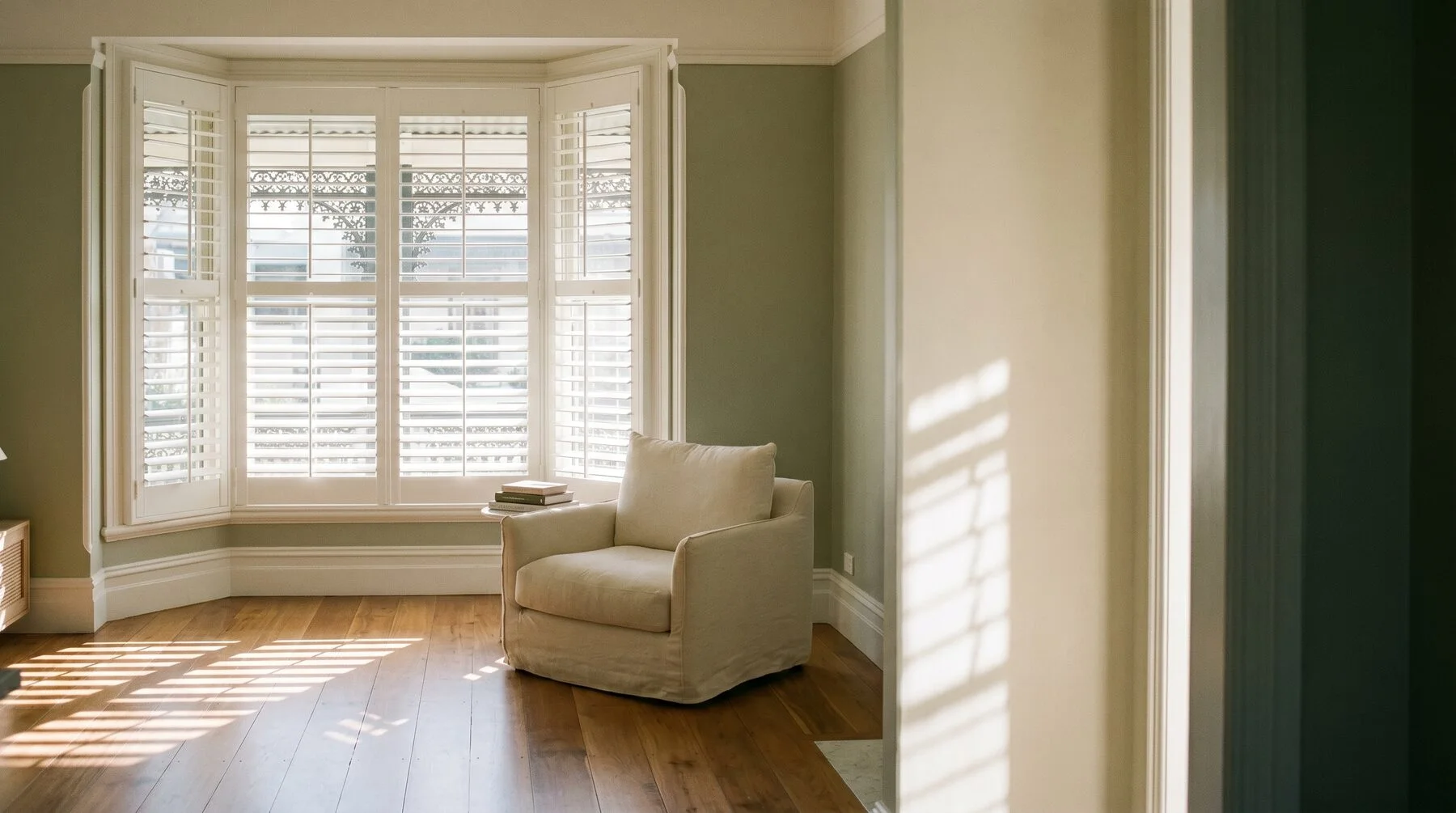
The reverse list is short but firm: giant contemporary blades on a Victorian sash, hidden tilt where every other fitting in the room is honest brass, and face-mounted frames slapped over original architraves when a reveal fit was available. None of these are catastrophes. All of them are the reason some renovations feel slightly wrong at the front door.
Shaped windows: the terrace's signature
Fanlights over doors, arch-top sashes, the occasional gable porthole: these are template jobs, measured full-size so the curve of the panel is the curve of your window. They're also the strongest argument for timber, which can be cut to any shape and painted to match. The mechanics are on the custom made shutters page; the short version is that shaped work is normal in this trade, not exotic.
Comfort, honestly framed
Old houses run draughty and bright: single glazing, gappy sashes, western sun straight down the hall in summer. Shutters help in exactly one honest way, they add a controllable layer of still air and shade at the window, which old rooms feel more than new ones because their windows are a bigger share of the wall. What they don't do is rewire physics: the sash still rattles until it's draught-sealed and the glass is still single. Our energy guide lays out what window coverings genuinely do, with the government sources, and no invented percentage.
The council question
Interior shutters are furniture as far as planning is concerned: no approval needed, ever. The care case is external shutters on a listed building or in a conservation area, several of the suburbs this guide is about sit inside one, where changes visible from the street can need a check first. The City of Newcastle's heritage pages, including its maps of listed items and conservation areas, are the primary source: newcastle.nsw.gov.au, heritage. Two minutes on the map beats an awkward letter later, and if your project is interior-only you can skip this paragraph entirely.
Sources
- City of Newcastle: Heritage, the council's own guidance for owners of heritage items and homes in conservation areas.
- City of Newcastle: Heritage listings and maps, where to check whether a specific address is listed or inside a conservation area.
Renovating a terrace? The measure visit reads old openings every week, and it's free
Book a free measure & quote