
A shutter is a hinged panel of framed slats that covers a window. Where a curtain hangs and a blind rolls, a shutter is built in: a piece of joinery fitted to the exact opening, opening and closing like a small door, with slats you tilt to let in precisely the amount of light and privacy you want. Done well, it outlasts every other window covering in the house.
Plantation shutters, specifically
A plantation shutter is the wide-louvred interior kind, the style you see across Australian homes: generous horizontal blades, usually 63 to 114 mm, in a painted or stained frame. The name comes from the grand houses of warm climates, but the design stuck because it suits ours: wide blades scoop breeze and light while keeping glare and neighbours out.
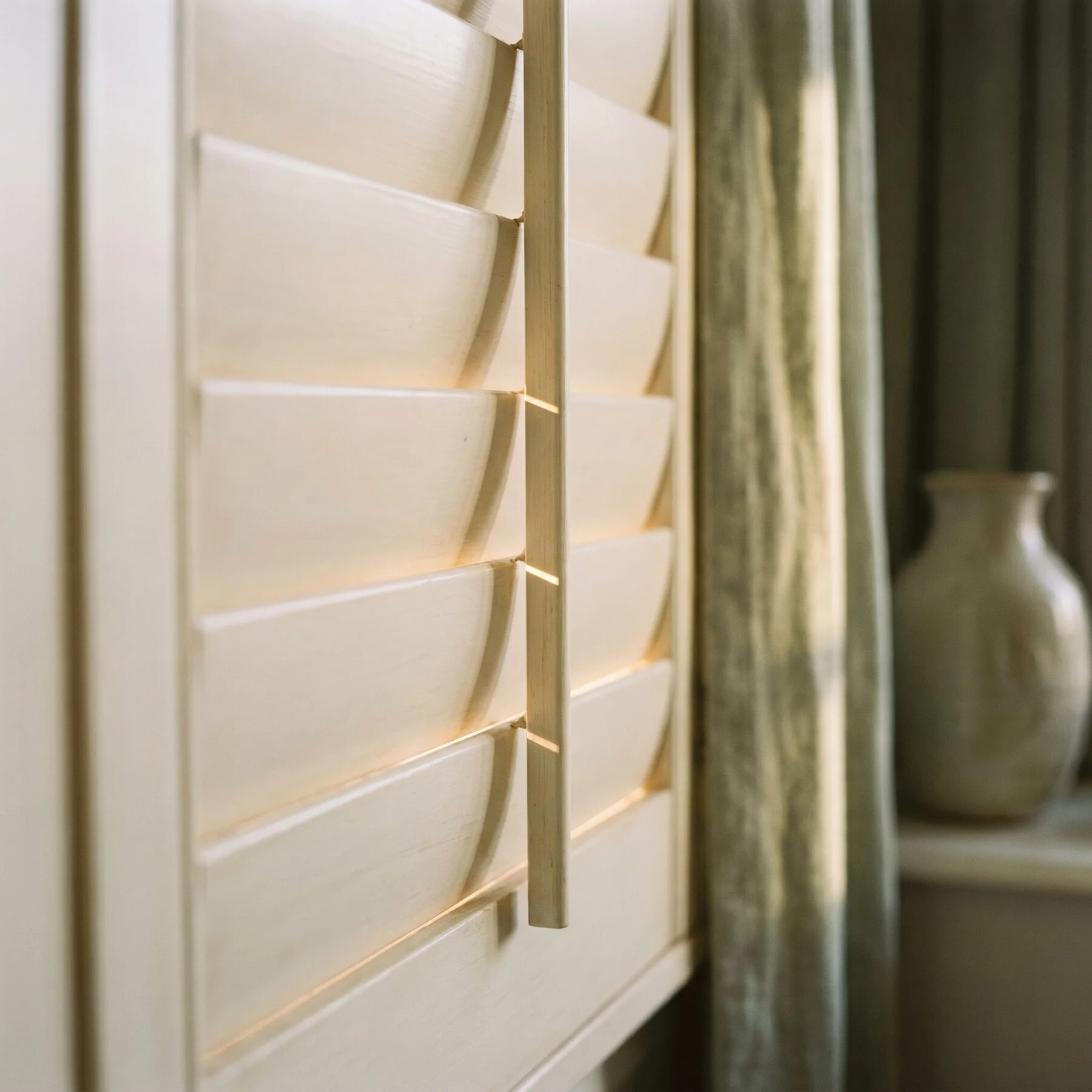
Interior and exterior
Interior shutters live inside the glass. They're the comfort product: light control, privacy, insulation, and the tailored look that suits both a terrace sash and a new-build slider. Nearly everything on this site is about them.
Exterior shutters live outside, facing the weather. In this region they earn their keep on exposed coastal openings and outdoor rooms, where they're usually aluminium, and they overlap with what folks call storm or security shutters. If your job is an outside one, say so in your enquiry, it changes the recommendation entirely.
The glossary
Each definition below stands on its own, so you can quote us at your measure.
Louvre (or blade)
The horizontal slat that tilts. Louvre width is the single biggest style decision on a shutter: 63 mm reads traditional, 89 mm is the safe modern middle, 114 mm is the big contemporary blade. See the louvre width guide.
Stile
The vertical member either side of a panel, the part your hand pushes when you swing it open.
Rail
The horizontal members at the top and bottom of a panel. Wider bottom rails read more traditional.
Mid-rail
A fixed horizontal bar partway up a panel that splits the louvres into two independently tilting banks. On a street-facing window you close the bottom bank for privacy and leave the top open for sky. If a room faces the footpath, ask for one.
Tilt rod, front and hidden
The mechanism that turns the louvres together. A front tilt rod runs vertically down the face of the panel, the traditional pattern. Hidden tilt (a slim connector at the back edge) leaves the face clean and modern. Full comparison in front tilt or hidden tilt.
Z-frame and L-frame
The frame profiles a shutter hangs in. An L-frame is a plain right angle, tidy inside a deep, square reveal. A Z-frame laps over the edge of the opening like an architrave, covering gaps and forgiving the out-of-square reveals that older houses collect.
Reveal mount and face mount
Reveal (inside) mount fits the shutter within the depth of the window opening, flush and built-in. Face mount fixes the frame to the wall around the opening, the answer when the reveal is shallow or winders and handles are in the way.
Café-style and tier-on-tier
Café-style shutters cover only the lower part of a window, privacy at street level, open sky above, a natural fit for Hamilton's close-set streets. Tier-on-tier covers the full window in two separately hinged banks, the most flexible (and most joinery-intensive) configuration.
Bi-fold and bypass (sliding)
How shutters handle openings too wide for hinged panels. Bi-fold panels concertina to the side; bypass panels slide past each other on a track. This is the estate slider's chapter, covered in custom made shutters.
Basswood, PVC and aluminium
The three materials that matter here: basswood is the light, stable furniture-grade timber; PVC (you'll also hear poly or vinyl) is the waterproof synthetic that owns wet rooms; aluminium is the powder-coated metal that shrugs off salt air. The room decides: material, room by room.
Quick questions
Are plantation shutters worth it over blinds?
Different jobs. Shutters win on lifespan, light control and the built-in look; blinds win on upfront cost and soft texture. We keep an honest scorecard in shutters vs blinds.
Do shutters block out all light?
Closed tight they come close, but louvres are not a blackout blind. For a nursery or shift-worker's bedroom, say so at your measure, there are combinations that get you the rest of the way.
Can you do shaped or arched windows?
Yes, that's exactly what made-to-measure is for. Arches, fanlights, rakes and circles are the home turf of custom made shutters.
Fluent already? Put the vocabulary to work, the free measure is where it pays off
Book a free measure & quote