
Most shutters-versus-blinds comparisons skip one trade-off. The shading that does most against summer heat sits outside the glass, and outside is where coastal salt air works on metal.
Put two sources side by side and the pattern is clear. The Australian Government's Your Home guide calls shading glass the best way to reduce unwanted heat gain. The stainless steel industry body ASSDA says conditions are very aggressive in rain-sheltered spots, such as under eaves, where rain does not wash the salt off, and under the eaves is where an external blind's brackets often sit. Indoors, ASSDA says tea staining is rarely a problem, because humidity is low and salt does not settle. Neither source says this next part; it is our reading of the two together. For a shutter or blind inside the glass, the sun is the harder test. For anything outside the glass, ask about the metal first.
That is how we at Newcastle Shutters would frame the choice. Our lifespan and durability comparison covers how long each type lasts in general. This guide covers what Hunter salt and sun do to them.
Where heat and salt each do their work
Outside the glass
- 1Outside the glass: shading stops heat before it enters. Effective shading blocks up to 90% (Your Home)
- 2Under the eaves: rain-sheltered, very aggressive for tea staining (ASSDA)
Inside the glass
- 3Inside the glass: works after the heat reaches the glass. Some thermal effect with a good seal (Renew)
- 4Indoors: tea staining on stainless rarely a problem, low humidity, no salt deposits (ASSDA)
Your Home names the best fix for east- and west-facing glass outright: "adjustable vertical shading, such as external blinds, is the optimum solution". The same page says direct sun can generate about the same heat as a single bar radiator per square metre, and that effective shading can block up to 90% of it.
Renew, the non-profit behind Sanctuary magazine, agrees: if summer heat gain is your main concern, "it's best to keep the sun off the glass in the first place with an external shading device".
So the hot-weather champion is an outdoor product, and it carries the salt exposure that comes with being outdoors. An indoor shutter or blind avoids most of that exposure but starts its work later, once the sun has already come through the glass.
Why an inside shutter or blind starts behind the heat
Windows matter more than most people expect. Your Home says up to 87% of a home's heat is gained, and up to 40% of its heating energy lost, through windows.
Inside coverings still earn their place. Your Home says "window furnishings (for example, louvres, blinds, curtains) can be used to improve the thermal performance of your windows", and notes they are especially useful on existing windows. Renew's author calls interior shutters the next best thing to external ones, and David Baggs of Global GreenTag tells Renew louvres "do have some thermal effect when used inside if you can get a good seal".
Fit decides how much of that you get. The federal energy site recommends close-fitting lined curtains or blinds and pelmets, and says rattling or whistling in the wind signals gaps that need sealing.
The habit matters as much as the product. In warmer months, close coverings during the day and open them at sunset to let the evening breeze through. The ACT Government gives the same day-close, evening-open advice. For the late-afternoon side of the house, our El Niño summer guide to west-facing windows goes further.
The building code's 80% figure is not a rating of shutters or blinds: the NCC 2022 energy-efficiency specification recognises external shutters or blinds only if they restrict at least 80% of summer solar radiation reaching the glass, counts adjustable ones only if they are automatically operated, and is a compliance rule for new apartment and commercial buildings (NCC Volume One, Class 2 to 9), not for houses and not a measure of any interior product.
Shutters or blinds: which does more for heat inside?
| Covering | What Renew says about heat | Light and privacy |
|---|---|---|
| Venetian blinds | "of limited help with thermal performance" | help with sunlight and privacy |
| Vertical blinds | "of limited help with thermal performance" | help with sunlight and privacy |
| Snug-fitting honeycomb blinds | do better on thermal performance | No entry |
| Enclosed side-track roller blinds | do better on thermal performance | No entry |
| Plantation shutters (usually timber or PVC) | some thermal effect inside "if you can get a good seal" (David Baggs, quoted by Renew); next best thing to external shutters | give privacy, block considerable light even with blades open |
| External shading device | best for minimising summer heat gain, keeps the sun off the glass | No entry |
The type matters more than the label. Renew's 2017 guide says vertical blinds and standard venetians help with sunlight and privacy but are "of limited help with thermal performance". It finds that snug-fitting honeycomb blinds and enclosed side-track roller blinds do better.
Plantation shutters, usually timber or PVC, give privacy but block considerable light even with the blades open. Whether that suits you depends on the room. Louvres can also be tilted to trade light against privacy and airflow through the day, which a flat blind cannot do.
The deciding question is often simpler: will you actually use it? Renew notes that blinds and curtains only deliver benefits if they are actually used, and that hard-to-reach blinds tend to get left open.
There are rooms where a blind is the better answer, and our Blinds Newcastle page sets those out. The energy-saving page covers the running-cost side.
Near the coast, ask about the metal first
Surf to about 5 km
Tea staining most common here, worse closer to the sea. Grade 316 stainless or equivalent the minimum (ASSDA). Grades 304 or 430 will probably tea stain or corrode more severely.
Beyond, out to 20 km or more
Wind, pollution and heat can extend tea staining to 20 km or more.
The same factors also increase corrosion rates of alternative materials.
Rain-sheltered spots such as under eaves: very aggressive, salt is not rinsed off
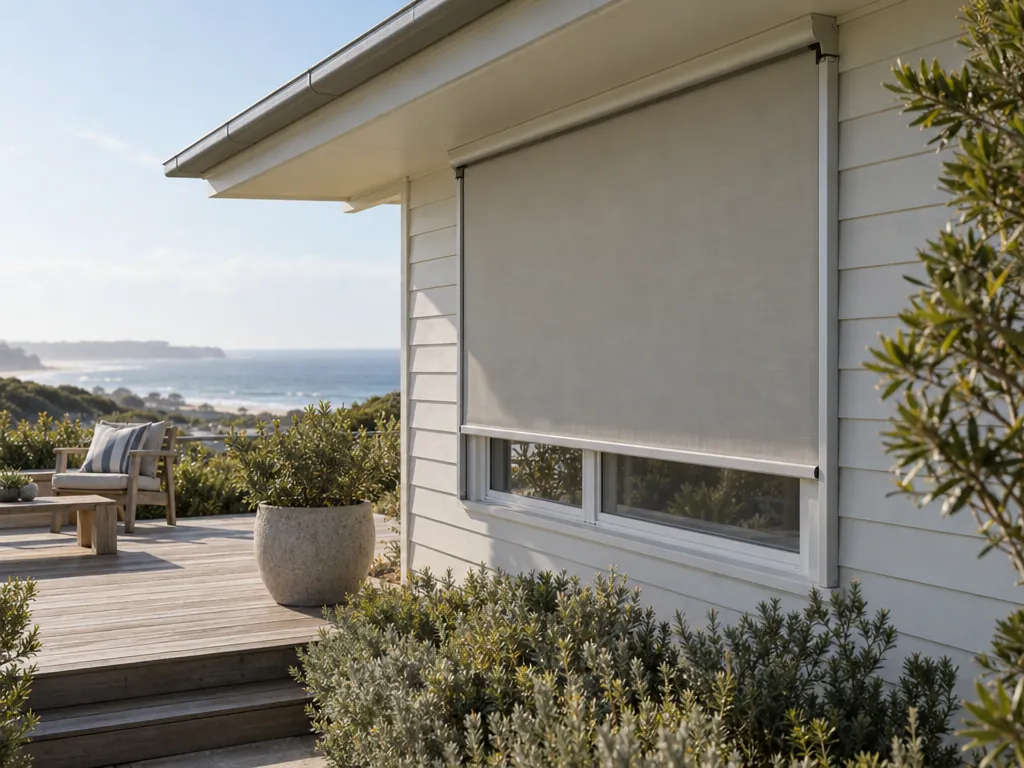
On a coastal home, the fabric or blade is rarely where the questions should start. Start with the metal: brackets, tracks, screws, hinges, pins and chains.
ASSDA's guidance is about stainless steel, and it is specific. Tea staining, the brown discolouration you see on coastal fittings, is "a cosmetic issue that does not affect the structural integrity or the lifetime of the material". It turns up most often within about 5 km of the surf and worsens closer to the sea. Wind, pollution and heat can push it out to 20 km or more. ASSDA adds that "these same factors also increase corrosion rates of alternative materials", so switching away from stainless does not take a part out of the salt's reach.
On grade, ASSDA puts grade 316 (or equivalent) as the minimum within 5 km of the surf. It says lower grades such as 304 or 430 "will probably become tea stained or even suffer more severe corrosion in a marine environment". Don't assume a grade. Ask what it is.
Sheltered does not mean safe. Spots under eaves miss the rain that would rinse salt away, and stainless is not generally maintenance free. A light, regular wash helps.
If external shade is on your list, our awnings page covers shade outside the glass. Anything outside also faces wind, which our damaging winds guide deals with.
North and west windows: sun on fabric and moving parts
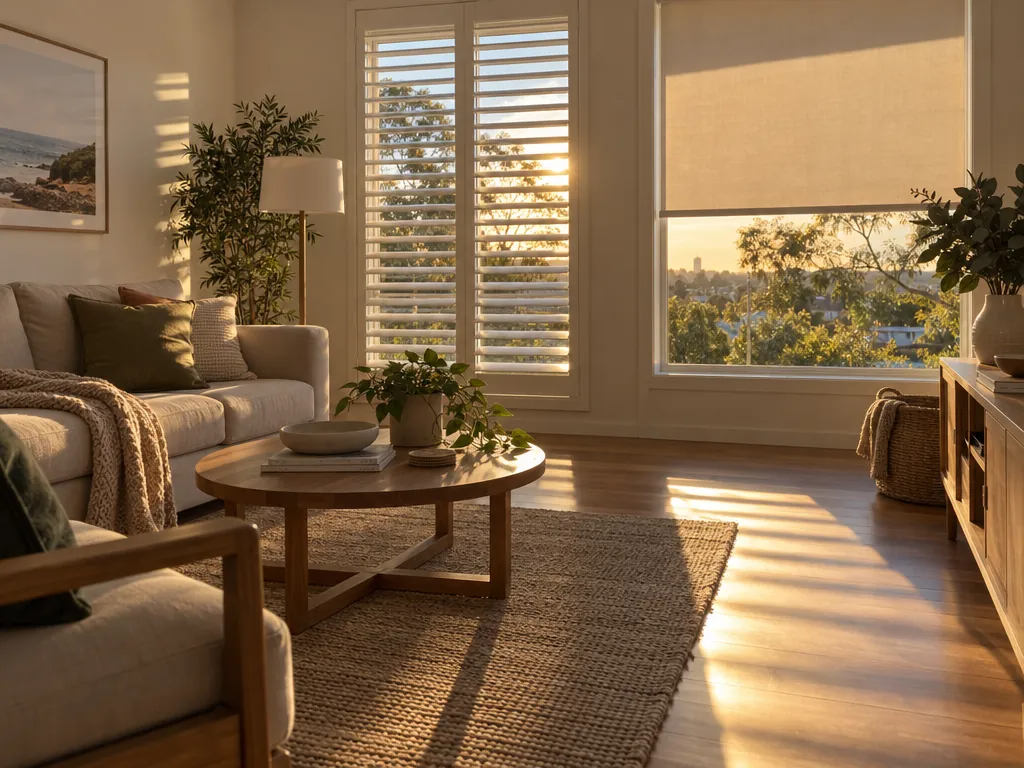
Inside the glass, the sun does the slow work. Renew says interior furnishings still need to withstand strong sunlight, especially on north and west windows. It advises choosing good materials, "particularly backing fabric", and asking about expected lifespan and warranties.
On a blind, that means the fabric's back face and the mechanism that raises and lowers it. On a shutter, it means the panel material and the parts that tilt the louvres. No covering is immune to sun, so ask how each part is expected to hold up on your window's orientation. Our guide to timber, PVC or aluminium by room covers material choice.
Corded blinds: the NSW installation rules
- 1Cord cleat: at least 1,600 mm above the floor
- 2Not permitted: a loose cord that can form a loop of 220 mm or longer at or below 1,600 mm above the floor
- 3Continuous loop that can't be cut: needs a safety device
- 4Installer's label: name and contact details
Any corded blind or curtain in NSW comes with installation rules. NSW Fair Trading says it must be installed so that a loose cord cannot form a loop of 220 mm or longer at or below 1,600 mm above the floor. A cord cleat must sit at least 1,600 mm above the floor.
Some vertical blind and curtain cords need a continuous loop that cannot be cut, so they need a safety device. The installer must also attach a label with their name and contact details.
Whatever you choose, ask how it operates and where any cord will end up, before anything goes on the wall.
Questions to ask any supplier
- Metal grade. Within about 5 km of the surf, are the stainless parts grade 316 or equivalent? That is ASSDA's minimum there.
- Exposed parts. Which parts sit outside or under the eaves, and how should they be washed? Stainless is not generally maintenance free.
- Backing fabric. How will it hold up on a north or west window? Renew flags the backing fabric in particular.
- Lifespan and warranty. What lifespan should I expect, and what does the warranty cover? Renew suggests asking about both.
- Fit. How will it be fitted to close gaps? The energy site ties temperature control to close fitting.
- Cords. If it has cords, is the cleat at least 1,600 mm up, with no loose loop of 220 mm or longer at or below 1,600 mm? Is there a safety device on any continuous loop, and an installer label? These are the NSW requirements.
- Reach. Can I operate it easily every day? Hard-to-reach blinds tend to get left open.
Choosing by room in a Hunter home
Sun, salt and cords: the numbers in one place
Sun
- Up to 87% of a home's heat gained through windows Your Home: glazing
- Up to 40% of heating energy lost through windows Your Home: glazing
- Effective shading blocks up to 90% of direct sun's heat Your Home: shading
- NCC 2022 Volume One (apartments and commercial buildings, not houses): external shutters or blinds recognised if they restrict at least 80% of summer solar radiation reaching the glass; adjustable ones only if automatically operated. Not a rating of interior products NCC 2022 Volume One, J energy efficiency
Salt
- Tea staining most common within about 5 km of the surf, up to 20 km or more with wind or pollution ASSDA: coastal corrosion and tea staining
- Grade 316 or equivalent the minimum within 5 km of the surf ASSDA: coastal corrosion and tea staining
Cords
- No loose cord loop of 220 mm or longer at or below 1,600 mm above the floor; cleat at least 1,600 mm up NSW Government: blind and curtain safety
West- or east-facing living areas. Your Home's optimum for east and west glass is adjustable external shading. Inside, choose a covering you can fit snugly and will close in the afternoon.
Bedrooms. Plantation shutters block considerable light even with blades open. Some sleepers want that and some don't, so decide which you are first.
Children's rooms. If you choose a corded blind, check it against the NSW cord rules before it goes up.
Bathrooms, kitchens and laundries. Here moisture matters more than salt. Our material-by-room guide covers it.
High or awkward windows. Pick the covering you will actually operate. An unused blind delivers nothing.
Close to the surf. For any part outside the glass, ask about the metal grade first.
Talk it through with Newcastle Shutters
If you are weighing shutters against blinds for a particular room, bring this list with you and ask every question on it, of us and of the local provider who measures. You can work through it room by room on our Talk It Through page. When you are ready to see the windows measured, book a measure and quote and tell us which way each window faces and how far you are from the beach.
Sources
- https://www.yourhome.gov.au/passive-design/shading
- https://www.yourhome.gov.au/passive-design/glazing
- https://renew.org.au/sanctuary-magazine/ideas-advice/not-just-window-dressing-high-performance-curtains-blinds-and-shutters/
- https://www.assda.asn.au/publications/technical-faqs/preventing-coastal-corrosion-tea-staining
- https://www.energy.gov.au/households/windows
- https://www.climatechoices.act.gov.au/energy/energy-efficiency/window-glazing-or-treatments
- https://ncc.abcb.gov.au/editions/ncc-2022/adopted/volume-one/j-energy-efficiency/37-calculation-u-value-and-solar-admittance
- https://www.nsw.gov.au/legal-and-justice/consumer-rights-and-protection/safety/other-consumer-products/blind-and-curtain-safety